

Koha backup is not only a technical task. It is the safety plan for your library system.
Koha stores important library data, including catalogue records, item barcodes, patron records, checkouts, holds, fines, notices, reports, staff permissions, and system settings. If your Koha server fails, a good backup can save days or even weeks of manual recovery work.
This Koha backup and restore guide explains the safest beginner-friendly methods for backing up and restoring Koha on a Linux server. It covers Koha package tools such as koha-dump, koha-run-backups, and koha-restore.
It also explains manual MySQL or MariaDB backup using mysqldump.
This guide is written for beginners who manage package-based Koha installations on Debian or Ubuntu.
You will learn what to back up, how to find your Koha instance name, how to restore safely, how to rebuild the search index, and how to test Koha after recovery.
What Is the Best Way to Back Up Koha?
For most package-based Koha installations, the best beginner-friendly backup method is koha-dump.
It creates a Koha database dump and a configuration archive for the Koha instance.
For scheduled backups, use koha-run-backups.
Use mysqldump only when you need a database-only backup because it does not include Koha configuration files, uploaded files, OPAC customizations, Apache settings, or other server-level files.
A safe Koha backup plan should include three things:
- A full Koha backup.
- An off-server copy.
- A tested restore process.
You may also Like: Koha Troubleshooting Guide for Beginners
Why Koha Backups Matter for Every Library
Koha stores important library data in a database. The data can include bibliographic records, item records, barcodes, patrons, checkouts, renewals, holds, fines, reports, notices, system preferences, and staff permissions.
Losing this data can stop circulation, damage patron trust, and make catalog recovery difficult.
A backup protects your library when something goes wrong.
It helps when a server crashes, a database import fails, a Koha upgrade breaks, a staff member deletes data by mistake, or a migration does not go as planned.
For a small school library, a backup may protect a few thousand records.
For a college, university, or public library, it may protect years of circulation history and cataloging work.
A good backup plan should answer three simple questions:
- What data is backed up?
- Where is the backup stored?
- Has the backup been restored successfully in a test environment?
A backup that has never been tested is only a hope.
A tested restore is a real recovery plan.
What Data Should a Complete Koha Backup Include?
A complete Koha backup should include more than the MySQL or MariaDB database.
Many beginner tutorials only show how to export the Koha database.
That is useful, but it is not a complete disaster recovery plan.
Koha can also depend on configuration files, uploaded files, OPAC customizations, search indexes, Apache settings, cron jobs, and backup logs.
| Koha Data | Why It Matters | Backup Priority |
|---|---|---|
| Koha database | Stores bibliographic records, items, patrons, checkouts, holds, fines, reports, notices, and settings | Very high |
| Koha configuration files | Store instance settings, database credentials, ports, and paths | Very high |
| Uploaded files | Needed if your Koha uses file uploads or attached documents | High |
| OPAC customizations | Include custom CSS, JavaScript, logos, images, and theme settings | High |
| Zebra indexes | Help Koha search work quickly after restore | Medium |
| Cron job settings | Run notices, indexing, cleanup, fines, and other background tasks | High |
| Apache or web server configuration | Helps restore URLs, ports, and site access | Medium |
| Backup logs | Help confirm that backups completed successfully | Medium |
If you only back up the database, you may still be able to recover records and patrons.
However, you may lose custom design files, uploaded documents, local configuration, web server settings, or automation settings.
That is why koha-dump is usually safer than a basic mysqldump backup for package-based Koha systems.
Read Also: Koha SQL Reports Generator
Koha Backup Methods Compared
Different backup methods serve different purposes.
Beginners often ask which method is best.
For modern package-based Koha installations, koha-dump is usually the best starting point because it is made for Koha instances.
| Method | Best For | What It Backs Up | Beginner Rating |
koha-dump | Full backup of one Koha instance | Database and Koha site/configuration files, with options for uploaded files and indexes | Best default option |
koha-run-backups | Automated scheduled backups | Uses koha-dump and keeps backups for a selected number of days | Best for production |
mysqldump | Database-only backup or manual migration | Koha database only | Useful but incomplete |
| MARC export | Catalog record preservation | Bibliographic, item, or authority records | Not a full backup |
Use koha-dump for a full backup. Similarly, use koha-run-backups for scheduled backups.
Before You Start: Beginner Safety Checklist
Before running backup or restore commands, collect the basic details of your Koha system.
This avoids common mistakes and makes recovery safer.
| Item | Example |
| Koha instance name | library |
| Koha database name | koha_library |
| Koha version | 24.11, 25.05, or newer |
| Server OS | Ubuntu or Debian |
| Backup location | /backups/koha/ |
| Free disk space | More than database size plus uploaded files |
| Root or sudo access | Required for most commands |
| Off-server storage | Another server, external drive, or secure cloud storage |
| Test restore plan | Separate test server or virtual machine |
Warning: Do not restore a live Koha database without creating a fresh backup first.
Restore commands can overwrite existing records, patrons, circulation history, reports, notices, and system settings.
Important: Use the Koha instance name with Koha commands.
Use the database name with MySQL or MariaDB commands.
For example, if your instance name islibrary, your database name is usually koha_library.
How to Find Your Koha Instance Name
The Koha instance name is not always the same as the database name.
This is one of the most common beginner mistakes.
Run this command:
sudo koha-list --enabledIf the output is:
libraryThen your Koha instance name is:
libraryYour database name is usually:
koha_libraryUse the instance name with Koha commands such as:
sudo koha-dump library
sudo koha-upgrade-schema library
sudo koha-rebuild-zebra -v -f library
Use the database name with MySQL or MariaDB commands such as:
sudo mysqldump -u root -p koha_library > koha_library.sqlMethod 1: Full Koha Backup Using koha-dump
For a package-based Koha installation, the easiest full backup command is:
sudo koha-dump libraryReplace library with your real Koha instance name.
This creates backup files for the Koha instance.
A typical backup includes:
- A compressed SQL database dump.
- A compressed configuration and site archive.
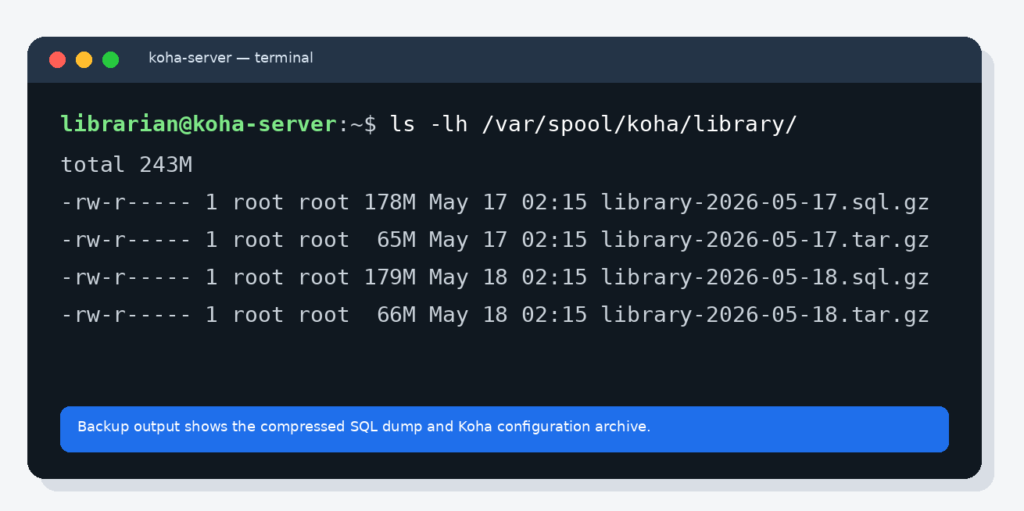
You may find the backup files under a Koha spool or backup directory such as:
/var/spool/koha/library/Check the files with:
ls -lh /var/spool/koha/library/You may see files similar to:
library-2026-05-17.sql.gz
library-2026-05-17.tar.gz
The .sql.gz file contains the database dump.
The .tar.gz file contains Koha configuration and site-related files.
Include Uploaded Files in the Backup
If your library uses Koha uploaded files, include them in the backup.
Run:
sudo koha-dump --uploaded_files libraryIf temporary uploaded files also matter, run:
sudo koha-dump --uploaded_files --uploaded_temp_files libraryThis is useful when Koha stores attached files, documents, or other uploaded materials.
Exclude Zebra Indexes to Reduce Backup Size
Zebra indexes can make backup files larger.
If you want a smaller backup and you are comfortable rebuilding the search index after restore, use:
sudo koha-dump --exclude-indexes libraryThis keeps the backup lighter.
However, after restoring Koha, you must rebuild Zebra so OPAC and staff search work correctly.
Method 2: Automated Koha Backups Using koha-run-backups
A one-time backup is not enough for a live library.
You need regular backups.
Koha includes koha-run-backups, which can create scheduled backups and keep them for a selected number of days.
Example command:
sudo koha-run-backups --output /backups/koha --days 7This command stores backup files under an instance folder inside the output directory.
For example, if your instance is called library, the files may be stored under:
/backups/koha/library/The command keeps backups for 7 days.
To check the files, run:
ls -lh /backups/koha/library/If you want smaller backups, you can exclude Zebra indexes:
sudo koha-run-backups --output /backups/koha --days 7 --exclude-indexesFor a beginner-friendly production setup, keep at least 7 daily backups and one weekly off-server backup.
If your library has heavy circulation, keep backups for a longer period.
A better plan may include 30 daily backups, weekly backups for several months, and a monthly archive.
Method 3: Manual Koha Database Backup Using mysqldump
Manual database backup is useful when you only need the database. It is also common in older Koha migration tutorials.
However, remember that mysqldump backs up the database only.
It does not automatically back up:
- Koha configuration files.
- Uploaded files.
- OPAC design files.
- Apache settings.
- Cron jobs.
- Local scripts.
- Search indexes.
Basic database backup:
sudo mysqldump -u root -p koha_library > koha_library.sqlCompressed database backup:
sudo mysqldump -u root -p koha_library | gzip > koha_library.sql.gzSafer backup for InnoDB tables:
sudo mysqldump -u root -p \
  --single-transaction \
  --routines \
  --triggers \
  --events \
  koha_library | gzip > koha_library_$(date +%F).sql.gz
This is helpful for a database-only backup. Still, it should not replace a full Koha backup plan.
How to Restore Koha Using koha-restore
Use koha-restore when your backup was created with koha-dump.
The restore command needs two files:
library-2026-05-17.sql.gz
library-2026-05-17.tar.gz
Run:
sudo koha-restore library-2026-05-17.sql.gz library-2026-05-17.tar.gzUse this method on a clean or prepared server.
The restore process may stop if files from the configuration dump already exist on the server.
This is a safety check to reduce the risk of accidental overwriting.
Warning: Do not run
koha-restorecasually on a live server. Test it first on a separate server or virtual machine whenever possible.
Screenshot Placeholder
Add a screenshot here showing a successful restore command output.
Use a caption such as:
Successful Koha restore using koha-restore.
How to Restore a Manual SQL Backup to a New Koha Server
Use this method when you only have a .sql or .sql.gz database backup.
This method is useful, but it is not as complete as restoring a full koha-dump backup.
Step 1: Stop Services
Stop Apache:
sudo systemctl stop apache2Stop memcached:
sudo systemctl stop memcachedIf your Koha uses Plack, stop it:
sudo koha-plack --stop libraryReplace library with your Koha instance name.
Step 2: Open MySQL or MariaDB
sudo mysql -u root -pStep 3: Drop and Recreate the Database
Warning: This removes the current Koha database.
Only run this if you are sure you are restoring the correct backup.
DROP DATABASE koha_library;
CREATE DATABASE koha_library CHARACTER SET utf8mb4 COLLATE utf8mb4_unicode_ci;
EXIT;
Step 4: Import the Backup
For an uncompressed SQL file:
sudo mysql -u root -p koha_library < koha_library.sqlFor a compressed SQL file:
gunzip -c koha_library.sql.gz | sudo mysql -u root -p koha_libraryAfter importing, continue with schema upgrade, search index rebuild, service restart, and testing.
Why Schema Upgrade Is Important After Restore
When you restore an older Koha database into a newer Koha installation, the database structure may not match the new Koha code.
That is why you may need to run:
sudo koha-upgrade-schema libraryThink of schema upgrade like adjusting the shelves before placing the books back.
Your data may be present, but the newer Koha version needs the database structure to match its current rules.
Run this command especially when:
- You moved a database from an older Koha version to a newer version.
- You imported a manual SQL backup.
- You migrated from an old server to a new server.
- The staff interface shows database or upgrade warnings.
Use the Koha instance name, not the database name.
Correct:
sudo koha-upgrade-schema libraryIncorrect:
sudo koha-upgrade-schema koha_libraryWhy Search Index Rebuild Is Important After Restore
After restoring Koha, your records may exist in the database but not appear correctly in OPAC or staff search.
This often happens because the search index needs to be rebuilt.
For Zebra-based Koha installations, run:
sudo koha-rebuild-zebra -v -f libraryIf search is broken after restore, do not panic.
First confirm the database imported correctly.
Then rebuild the search index, restart services, and test OPAC search again.
Note About Zebra, Elasticsearch, and OpenSearch
This guide mainly uses Zebra commands because Zebra is common in package-based Koha installations.
Some Koha systems may use Elasticsearch or another configured search setup.
If your Koha installation uses Elasticsearch or OpenSearch, follow the indexing steps for your configured search engine.
You can check the Koha SearchEngine system preference in the staff interface.
If you are not sure, ask your Koha administrator before running search rebuild commands.
Restart Services After Restore
After schema upgrade and search index rebuild, restart the main services.
Restart memcached:
sudo systemctl restart memcachedRestart Apache:
sudo systemctl restart apache2If using Plack, restart it:
sudo koha-plack --restart libraryIf needed, restart Zebra:
sudo koha-zebra --restart libraryNow open the staff interface and OPAC in your browser.
Post-Restore Testing Checklist
Do not stop after the command line says the restore is complete.
Test the system like a staff member and a patron.
| Area to Test | What to Check |
| Staff login | Staff account opens correctly |
| OPAC | Public catalog loads without errors |
| Search | Title, author, subject, barcode, and advanced search work |
| Bibliographic records | MARC records, items, call numbers, and barcodes appear |
| Patron records | Patron names, categories, permissions, and contact details appear |
| Circulation | Checkouts, check-ins, renewals, and holds work |
| Reports | Saved SQL reports are still available |
| Notices | Email templates and notices are present |
| System preferences | OPAC, circulation, cataloging, and staff settings are retained |
| Uploaded files | Attached files or uploaded documents open correctly |
| Cron jobs | Indexing, overdue notices, cleanup, and fines jobs are active |
| OPAC design | Logo, CSS, JavaScript, and theme settings look correct |
| Email sending | Test notice or email delivery if configured |
| Permissions | Staff roles and permissions still work correctly |
Common Koha Backup and Restore Errors
1. Wrong Instance Name
This happens when a user runs a Koha command with the database name instead of the Koha instance name.
Incorrect:
sudo koha-upgrade-schema koha_libraryCorrect:
sudo koha-upgrade-schema libraryUse this command to confirm the instance name:
sudo koha-list --enabled2. Search Does Not Work After Restore
The database may be restored correctly, but Zebra indexes may be missing or outdated.
Run:
sudo koha-rebuild-zebra -v -f libraryThen restart services and test OPAC search again.
3. Backup File Is Too Large
Large Zebra indexes, logs, and uploaded files can increase backup size.
If you need a smaller backup, exclude indexes and rebuild them after restoration.
sudo koha-dump --exclude-indexes libraryYou can also exclude logs when suitable:
sudo koha-dump --exclude-logs library4. Uploaded Files Are Missing
If you used only mysqldump, uploaded files were not included.
Use a Koha backup command with uploaded files included:
sudo koha-dump --uploaded_files libraryIf temporary uploaded files matter, use:
sudo koha-dump --uploaded_files --uploaded_temp_files library5. Restore Fails Because Files Already Exist
koha-restore may stop if files from the configuration dump already exist on the server.
This helps avoid accidental overwriting.
Use a clean server, or remove conflicting files only after confirming they are safe to replace.
6. Database Import Fails
A database import may fail because of:
- Wrong database name.
- Wrong MySQL user.
- Corrupt SQL file.
- Not enough disk space.
- Character set mismatch.
- Missing permissions.
Check the backup file first:
ls -lh koha_library.sql.gzTest whether the compressed file can be read:
gunzip -t koha_library.sql.gzIf this command returns no error, the gzip file is readable.
7. OPAC Design Looks Broken After Restore
If the OPAC design looks broken, check:
- Custom CSS.
- JavaScript.
- Logo files.
- Theme settings.
- Apache configuration.
- Uploaded media files.
- System preferences related to OPAC appearance.
A database-only restore may not include all custom design files.
Simple Backup Schedule for Small Libraries
A small library does not need a complex enterprise backup system. However, it does need consistency.
A backup that is never tested is not enough.
| Backup Task | Recommended Frequency |
| Database backup | Daily |
| Full Koha backup with configuration | Daily or weekly |
| Off-server copy | Daily or weekly |
| Test restore | Monthly |
| Pre-upgrade backup | Before every Koha upgrade |
| Backup log review | Weekly |
| Security review of backup storage | Monthly |
For a small library, a simple plan may look like this:
- Daily automated backup using
koha-run-backups. - Weekly off-server copy.
- Monthly test restore.
- Manual backup before every Koha upgrade.
- Backup logs checked every week.
Beginner Example: Moving Koha From an Old Server to a New Server
Imagine your old server has a Koha instance called library. You want to move it to a new server. On the old server, create a full backup:
sudo koha-dump --uploaded_files libraryCheck the backup files:
ls -lh /var/spool/koha/library/Copy the backup files to the new server:
scp /var/spool/koha/library/library-2026-05-17.* user@newserver:/backups/On the new server, go to the backup folder:
cd /backupsRestore using:
sudo koha-restore library-2026-05-17.sql.gz library-2026-05-17.tar.gzIf you restored an older database into a newer Koha version, run:
sudo koha-upgrade-schema libraryRebuild Zebra if needed:
sudo koha-rebuild-zebra -v -f libraryRestart services:
sudo systemctl restart memcached
sudo systemctl restart apache2
If using Plack:
sudo koha-plack --restart libraryFinally, test:
- Staff login.
- OPAC search. and koha other optional link: Patron records, Bibliographic records, Circulation, Holds, Reports etc.
Security Tips for Koha Backup Files
Koha backups can contain sensitive library data. This may include patron names, contact details, borrowing history, staff accounts, reports, and internal settings. Therefore treat backup files like confidential library records.
Create a protected backup directory:
sudo mkdir -p /backups/koha
sudo chmod 700 /backups/koha
Restrict backup file access:
sudo chmod 600 /backups/koha/*.gzIt is recommended not to store backups in a public web directory. Similalry also do not send unencrypted backup files through email. Use encrypted off-server storage whenever possible.
Good storage options include:
- A secure backup server.
- An encrypted external drive.
- A secure cloud storage account.
- A managed backup service.
- A private network storage location.
Also keep a written restore procedure.
During a real server failure, clear instructions save time.
Quick Command Summary
| Task | Command |
| List Koha instances | sudo koha-list --enabled |
| Full Koha backup | sudo koha-dump library |
| Backup with uploaded files | sudo koha-dump --uploaded_files library |
| Backup with temporary uploaded files | sudo koha-dump --uploaded_files --uploaded_temp_files library |
| Backup without Zebra indexes | sudo koha-dump --exclude-indexes library |
| Automated backup | sudo koha-run-backups --output /backups/koha --days 7 |
| Manual database backup | sudo mysqldump -u root -p koha_library > koha_library.sql |
| Compressed manual backup | sudo mysqldump -u root -p koha_library | gzip > koha_library.sql.gz |
| Restore Koha dump | sudo koha-restore file.sql.gz file.tar.gz |
| Restore manual SQL | sudo mysql -u root -p koha_library < koha_library.sql |
| Restore compressed SQL | gunzip -c koha_library.sql.gz | sudo mysql -u root -p koha_library |
| Upgrade schema | sudo koha-upgrade-schema library |
| Rebuild Zebra | sudo koha-rebuild-zebra -v -f library |
| Restart services | sudo systemctl restart memcached apache2 |
| Restart Plack | sudo koha-plack --restart library |
| Restart Zebra | sudo koha-zebra --restart library |
Final Thoughts
A good Koha backup and restore plan is more than one command. You should understand what Koha ILS stores, which backup method fits your situation, where backup files are kept, and how to test the system after recovery.
For most modern package-based Koha servers, start with koha-dump full backups. Use koha-run-backups for automation. Perform the restore process on a test server. Document every step.
This is the safe way for library staff to turn a backup file into a real recovery plan. For official Guidelines, please visit the Koha community
FAQs About Koha Backup
For package-based Koha installations, the best beginner-friendly method is usually koha-dump.
It is designed for Koha instances and can create both a database dump and a configuration archive.
If you want scheduled backups with retention settings it is recommended to use koha-run-backups.
mysqldump enough for Koha?mysqldump is enough for a database-only backup. but it is not enough for a complete Koha backup.
koha-dump and mysqldump?koha-dump is a Koha-specific backup tool that backs up the Koha database and important Koha site/configuration files. While mysqldump is a MySQL or MariaDB tool. It only backs up the selected database.
koha-run-backups?koha-run-backups is a Koha backup automation tool. It runs backups for enabled Koha instances and keeps backups for a selected number of days. It uses koha-dump to create the backup files.
The exact location depends on your command and Koha configuration.
Many package-based backups are stored under:/var/spool/koha/
If you run:sudo koha-run-backups --output /backups/koha --days 7
the files may be stored under an instance folder such as:/backups/koha/library/
Yes, in most manual restore or migration cases, you should rebuild Zebra.
If you skip this step, records may exist in the database but fail to appear correctly in OPAC or staff search.
Use:sudo koha-rebuild-zebra -v -f library
koha-upgrade-schema?koha-upgrade-schema updates the Koha database structure so it matches the installed Koha version. It is especially important when restoring an older Koha database into a newer Koha installation.
After importing the old database, run the schema upgrade, rebuild the search index, restart services, and test all important library workflows.
Very old Koha versions may need a staged migration plan.
Include Zebra indexes if you want faster recovery and have enough storage.
Exclude them if you want smaller backups and are comfortable rebuilding the index after restore.
Use:sudo koha-dump --exclude-indexes library
A live library should usually back up Koha daily.
Small libraries can keep 7 to 30 days of backups.
Larger libraries should use longer retention, off-server storage, and regular restore testing.
Yes. A backup is only useful if it can be restored.
Test your Koha restore process on a separate server or virtual machine at least once a month.

[…] Koha backup and restoration guide explains this process in more […]