Affiliate marketing sounds simple at first.
You join an affiliate program, promote a product, and earn a commission when someone buys through your link.
But the hard part is traffic.
Most beginners publish affiliate articles on a new website and then wait months for Google rankings. Some never get traffic because their site has no authority, no backlinks, and no topical trust.
This is where Parasite SEO can help.
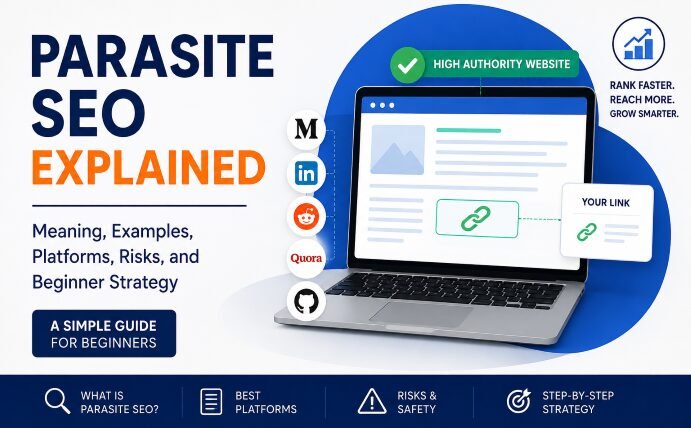
Parasite SEO is the practice of publishing helpful content on high-authority third-party platforms so the content has a better chance of ranking faster. When used properly, it can support an affiliate strategy by bringing early visibility, testing keywords, and sending targeted readers to your affiliate content.
However, this strategy must be handled carefully. Low-quality affiliate posts, fake reviews, copied product descriptions, and spammy links can damage trust and create SEO risk.
This guide explains how to use Parasite SEO for affiliate marketing in a safer, practical, and beginner-friendly way.
What Is Parasite SEO in Affiliate Marketing?
Parasite SEO in affiliate marketing means publishing affiliate-related content on a trusted third-party website instead of relying only on your own website.
The goal is to use the authority of platforms that already rank well in search engines.
These platforms may include:
- Medium
- Quora
- YouTube
- Substack
- GitHub Pages
- Niche guest blogs
- Product comparison platforms
- Business directories
- Community websites
For example, instead of publishing only one article on your new website about “best email marketing tools for beginners,” you could also publish a helpful beginner guide on Medium or LinkedIn.
That third-party page may rank faster because the platform already has authority.
You can then use that content to send readers to:
- a full comparison guide on your website
- a product review
- an email signup page
- a free checklist
- a useful tool
- an affiliate landing page, where allowed
The key is to make the content genuinely useful. Parasite SEO should not mean dumping affiliate links on authority platforms.
Read Aslo: off-page seo strategy-2026
Why Beginners Use Parasite SEO for Affiliate Marketing
Beginners usually face the same problem: their own site has no authority yet.
A new affiliate website may have good content, but it still needs time to build trust. Search engines may not rank it quickly, especially for competitive commercial keywords.
Parasite SEO can help because established platforms often have:
- stronger domain authority
- faster indexing
- existing user trust
- built-in audiences
- active communities
- stronger backlink profiles
This can give your affiliate content an early traffic source while your own website grows.
Think of it like renting space in a busy shopping mall while you are still building your own store. You get visibility sooner, but you still do not fully own the mall. That is why your own website should remain part of the strategy.
Parasite SEO Is Not a Shortcut for Bad Affiliate Content
Parasite SEO does not turn weak content into good content.
If your post is thin, copied, misleading, or full of forced affiliate links, it may fail even on a strong platform. Worse, the platform may remove it.
Good affiliate content needs to help people make better decisions.
That means your article should answer questions like:
- Who is this product best for?
- Who should avoid it?
- What are the pros and cons?
- What are the alternatives?
- What does it cost?
- What problem does it solve?
- What limitations should users know?
- Have you explained the product clearly?
- Are your affiliate links disclosed?
Affiliate SEO works best when readers feel informed, not pushed.
Read Also: On-Page SEO for WordPress: Beginner to Advanced Guide
Parasite SEO vs Normal Affiliate SEO
Both strategies can work, but they serve different purposes.
| Factor | Parasite SEO for Affiliate Marketing | Normal Affiliate SEO |
|---|---|---|
| Publishing location | Third-party platforms | Your own website |
| Ranking speed | Often faster | Usually slower |
| Control | Limited | Full control |
| Ownership | You do not own the platform | You own the site |
| Link freedom | Depends on platform rules | Full control |
| Long-term value | Medium | High |
| Best use | Testing keywords and gaining early visibility | Building a long-term affiliate brand |
| Risk | Platform removal or policy change | Algorithm and site quality risks |
A strong affiliate strategy uses both.
Use Parasite SEO for visibility and keyword testing. Use your own website for long-term authority, email capture, product hubs, and brand trust.
The Best Affiliate Niches for Parasite SEO
Parasite SEO can work in many niches, but some are better than others.
It works best when people actively search for reviews, comparisons, tutorials, or recommendations.
Good niches include:
- software tools
- web hosting
- WordPress plugins
- SEO tools
- email marketing software
- AI tools
- online courses
- productivity tools
- finance tools
- business services
- career platforms
- design tools
- ecommerce tools
- VPNs and cybersecurity tools
- home office products
- digital subscriptions
Be careful with sensitive niches such as health, finance, legal, and safety-related topics. These require stronger expertise, careful wording, and higher trust. Misleading claims in these areas can harm users and create compliance issues.
For beginners, software and digital tools are often easier because you can test products, take screenshots, compare features, and explain use cases clearly.
A Simple Affiliate Funnel Using Parasite SEO
A good affiliate strategy does not rely on one page only.
You need a simple funnel.
Here is a beginner-friendly structure:
| Funnel Stage | Purpose | Example Content |
| Awareness | Introduce the problem | “Why small businesses need email automation” |
| Education | Explain solutions | “How email marketing tools work” |
| Comparison | Help users compare options | “Mailchimp vs ConvertKit vs Brevo” |
| Decision | Recommend based on use case | “Best email tool for beginners” |
| Conversion | Send user to product or offer | Affiliate link, demo, trial, or signup page |
Parasite SEO works well at the awareness, education, and comparison stages.
For example, a LinkedIn article can explain the problem. A Medium article can compare solutions. Your own website can host the detailed buyer guide. Your affiliate links can appear naturally where they help the reader.
Step 1: Choose the Right Affiliate Product
Do not start with the platform. Start with the product.
A good affiliate product should have:
- real demand
- clear benefits
- trustworthy brand
- fair commission
- good landing page
- low refund rate
- helpful support
- positive user feedback
- enough information to review honestly
Avoid products that are low quality just because they offer high commission.
A bad product can damage your reputation. If people trust your recommendation and the product disappoints them, they will not trust your next article.
For beginners, choose products you can actually test or understand deeply.
Good examples include:
- SEO tools you use
- hosting services you have tested
- WordPress plugins you can demonstrate
- AI tools you can compare
- email marketing platforms you can review
- online courses you have taken
- productivity tools you can show in action
Your content becomes stronger when it includes real experience.
Step 2: Choose Low-Competition Affiliate Keywords
Keyword research is the heart of affiliate SEO.
Beginners often target keywords that are too competitive, such as:
- best web hosting
- best VPN
- best SEO tools
- best credit cards
These keywords are difficult because large websites already dominate them.
Start with long-tail keywords instead.
Examples:
- best SEO tools for new bloggers
- best email marketing software for coaches
- best WordPress hosting for small business sites
- best AI writing tool for product descriptions
- best project management tool for freelancers
- ConvertKit vs Mailchimp for beginners
- Semrush alternatives for small businesses
- Canva Pro review for bloggers
Long-tail keywords usually have lower search volume, but they are easier to rank and often convert better.
A person searching “best email marketing software for coaches” has a clearer need than someone searching “email software.”
Step 3: Match Keywords With Search Intent
Search intent means what the user really wants.
For affiliate marketing, this is very important.
There are four common types of search intent:
| Intent Type | User Wants | Example Keyword |
| Informational | Learn something | what is email marketing |
| Commercial | Compare options | best email tools for beginners |
| Navigational | Find a brand | ConvertKit pricing |
| Transactional | Buy or sign up | GetResponse free trial |
Affiliate content usually performs best with commercial investigation keywords.
These keywords include words like:
- best
- review
- vs
- alternatives
- comparison
- pricing
- discount
- for beginners
- for small business
- for bloggers
- for freelancers
However, do not ignore informational content. Informational articles build trust and can lead readers toward your comparison pages.
Step 4: Choose the Right Parasite SEO Platform
Different platforms work for different content types.
Do not publish every affiliate article on the same platform.
Use the platform that matches the topic and audience.
| Platform | Best For | Affiliate Use |
| Medium | Detailed guides and comparisons | Educational affiliate content |
| B2B tools and professional services | SaaS, marketing, business tools | |
| Quora | Answering specific questions | Soft recommendations and problem-solving |
| Community discussion | Careful, non-spammy insights | |
| YouTube | Reviews and tutorials | Demonstrations and affiliate links in description |
| Substack | Newsletter-based recommendations | Trust-building and recurring content |
| GitHub Pages | Technical tools and documentation | Developer tools and SaaS |
| Niche guest blogs | Relevant industry audiences | Expert reviews and tutorials |
For example, if you are promoting an SEO tool, LinkedIn, Medium, YouTube, and niche marketing blogs may work well.
If you are promoting a developer tool, GitHub Pages, technical blogs, and YouTube may be better.
If you are promoting a productivity tool, Medium, LinkedIn, Substack, and YouTube can all work.
Step 5: Build a Content Map
Do not publish random posts.
Create a simple content map around one affiliate product or product category.
Here is an example for an email marketing affiliate strategy.
| Content Type | Keyword Example | Platform |
| Beginner guide | how email marketing works for small business | Medium |
| Comparison post | Mailchimp vs ConvertKit for beginners | Your website |
| Q&A answer | is ConvertKit good for bloggers | Quora |
| Professional post | email automation tips for coaches | |
| Tutorial video | how to create your first email sequence | YouTube |
| Resource page | best email marketing tools for beginners | Your website |
This creates a small ecosystem.
Each piece supports the others. Readers can discover you on different platforms and move toward your main affiliate content.
Step 6: Create a Strong Main Affiliate Page on Your Own Website
Even if you use Parasite SEO, you should still have a main page on your own website.
This could be:
- a full product review
- a comparison guide
- a best tools list
- a tutorial
- a buyer guide
- a case study
- a free resource page
Your own page should be the most complete resource.
It should include:
- your disclosure
- product overview
- who it is best for
- who should avoid it
- pricing notes
- pros and cons
- screenshots
- alternatives
- FAQs
- final recommendation
- affiliate links
- personal testing notes if possible
This page becomes your central hub.
Your parasite pages can link to it naturally when readers need more detail.
Step 7: Write Helpful Parasite Pages
A parasite page should be valuable on its own.
Do not write a weak teaser that only exists to push people to your website.
For example, a Medium post should fully answer the topic. If you link to your website, the link should offer extra value.
Bad example:
“Click here to see the best SEO tool.”
Better example:
“I created a full comparison table with pricing, use cases, and beginner recommendations here.”
The second version gives readers a reason to click.
A strong parasite article should include:
- clear headline
- short introduction
- useful explanation
- examples
- comparisons
- practical steps
- natural link
- honest limitations
- clear disclosure if affiliate links are included
The goal is to earn trust before asking for a click.
Step 8: Use Affiliate Disclosures Clearly
Affiliate disclosures are not optional in many markets.
If you may earn money from a recommendation, say so clearly.
A simple disclosure can look like this:
“This article may contain affiliate links. If you buy through these links, I may earn a commission at no extra cost to you. I only recommend tools that I believe are useful for readers.”
Place the disclosure near the top of the article before affiliate links appear.
Do not hide it in the footer. Similalry do not use unclear wording. Do not assume readers will understand abbreviations.
Good affiliate disclosure builds trust. It tells readers you are being transparent.
Step 9: Use Natural Links Instead of Link Stuffing
Many beginners ruin Parasite SEO by adding too many links.
A good parasite page does not need ten affiliate links.
Use links only where they help.
For example:
- one link to your full review
- one link to a comparison page
- one link to a free checklist
- one affiliate link if the platform allows it
Some platforms do not allow affiliate links. while other allow them with disclosure. Some communities remove promotional links quickly.
Always follow platform rules.
If direct affiliate links are not allowed, link to your own helpful guide instead.
Step 10: Create Content for Each Stage of the Buyer Journey
A full affiliate strategy should not only target people ready to buy.
You also need content for people who are still learning.
Here is a complete journey.
Beginner Awareness Content
This helps people understand the problem.
Examples:
- What is email automation?
- Why small businesses need SEO tools
- How project management tools save time
- What is a VPN and who needs one?
Problem-Solving Content
This helps people fix a specific issue.
Examples:
- How to reduce abandoned carts with email
- How to track keyword rankings as a beginner
- How to organize client projects with one tool
- How to protect public Wi-Fi browsing
Comparison Content
This helps people choose between options.
Examples:
- Mailchimp vs ConvertKit
- Ahrefs vs Semrush
- Notion vs Trello
- NordVPN vs Surfshark
Best Product Content
This helps people make a final decision.
Examples:
- Best SEO tools for bloggers
- Best email marketing software for coaches
- Best project management tools for freelancers
- Best WordPress plugins for affiliate sites
Review Content
This helps people evaluate one product.
Examples:
- ConvertKit review
- Semrush review
- Grammarly review
- Canva Pro review
Parasite SEO can support all these stages, but your own website should hold the strongest final decision pages.
Step 11: Add Real Experience Where Possible
Affiliate content is much stronger when it includes experience.
Instead of only repeating product features, show how the product works.
Add:
- screenshots
- setup steps
- personal notes
- test results
- use case examples
- real pros and cons
- limitations
- who should not buy it
For example, instead of saying:
“This tool is easy to use.”
Say:
“I created a test campaign in about 15 minutes. The dashboard was simple, but the automation settings took longer to understand.”
That sounds more real and useful.
People trust specifics.
Step 12: Build Topic Clusters Around the Affiliate Product
One article is not enough for long-term SEO.
Create a topic cluster.
For example, if your affiliate product is an email marketing tool, your cluster could include:
- What is email marketing?
- Email marketing for beginners
- Best email marketing tools for bloggers
- Mailchimp vs ConvertKit
- ConvertKit review
- Email automation examples
- How to build an email list
- Email newsletter ideas
- Email marketing mistakes
- Best landing page tools for email signup
Each article supports the main affiliate page.
Your parasite pages can be used to promote some of these articles and bring traffic from authority platforms.
Step 13: Promote Without Spamming
Promotion matters, but spam can destroy trust.
Good promotion includes:
- sharing on your LinkedIn profile
- answering relevant Quora questions
- adding useful comments in communities
- linking from your newsletter
- embedding YouTube videos
- adding resources to your own website
- sharing in groups where promotion is allowed
Bad promotion includes:
- posting links in unrelated groups
- using fake comments
- mass-posting the same answer
- keyword stuffing
- hiding affiliate links
- pretending to be a customer
- creating fake reviews
Parasite SEO should feel like useful distribution, not spam.
Step 14: Track the Right Metrics
Do not measure only rankings.
For affiliate marketing, rankings are useful, but commissions depend on the full journey.
Track:
- impressions
- clicks
- referral traffic
- affiliate link clicks
- email signups
- trial signups
- conversions
- commission rate
- refund rate
- page engagement
- platform engagement
A page that ranks lower but converts better can be more valuable than a page with high traffic and no buyers.
For example, a keyword like “ConvertKit pricing for bloggers” may get less traffic than “email marketing,” but it can convert better because the user is closer to buying.
Step 15: Improve Pages Based on Data
Affiliate SEO needs updates.
After publishing, review your pages every few weeks or months.
Improve:
- outdated pricing
- old screenshots
- missing alternatives
- weak introductions
- unclear comparisons
- poor calls to action
- broken links
- thin sections
- missing FAQs
If a parasite page starts ranking, make it stronger. Add more value, clearer examples, and better internal links where allowed.
If your own affiliate page gets traffic but no conversions, improve the recommendation, comparison table, and call to action.
Example Parasite SEO Affiliate Strategy
Let’s build a simple example.
Niche: email marketing software
Affiliate product: ConvertKit
Audience: beginner bloggers
Main Website Page
Title:
ConvertKit Review for Beginner Bloggers: Features, Pricing, Pros, Cons, and Alternatives
This page includes:
- disclosure
- product overview
- screenshots
- pricing explanation
- pros and cons
- Mailchimp comparison
- who should use it
- who should avoid it
- FAQs
- affiliate link
Medium Article
Title:
How Beginner Bloggers Can Start Email Marketing Without Feeling Overwhelmed
This article explains the problem and links naturally to your full ConvertKit review.
LinkedIn Article
Title:
Why Creators Should Build an Email List Before They Need One
This targets professionals and creators.
Quora Answer
Question:
Is ConvertKit good for beginner bloggers?
Answer with a balanced response. Mention pros, cons, and link to your full review only if allowed and helpful.
YouTube Video
Title:
ConvertKit Tutorial for Beginners: Create Your First Email Form
The video shows real steps and includes a clear affiliate disclosure in the description.
This strategy gives you multiple entry points. Some users find you through Google. While, some find you through YouTube. Some find you through LinkedIn or Quora.
Best Parasite SEO Content Types for Affiliate Marketing
Different content types work for different products.
| Content Type | Best For | Example |
| Beginner guide | Early-stage users | How to choose an SEO tool |
| Comparison | Buyers comparing options | Semrush vs Ahrefs |
| Product review | Brand-aware users | Surfer SEO review |
| Alternatives post | Users unhappy with a tool | Best Mailchimp alternatives |
| Tutorial | Users who need help | How to set up email automation |
| Checklist | Practical users | Website launch checklist |
| Case study | Trust-building | How I improved workflow with Notion |
| Q&A answer | Long-tail traffic | Is Canva Pro worth it? |
For beginners, comparison and tutorial content often works well because it naturally helps users make decisions.
Common Mistakes in Parasite SEO Affiliate Marketing
Publishing Thin Reviews
A review that only repeats the product’s sales page is not useful.
Add your own explanation, screenshots, examples, and honest opinion.
Promoting Too Many Products
If every article recommends ten tools, readers may feel confused.
Recommend based on use case.
For example:
- Best for beginners
- Best for agencies
- Best free option
- Best for ecommerce
- Best for advanced users
Ignoring Disclosure
Affiliate disclosures build trust and may be legally required depending on your country and audience.
Make them clear.
Choosing Platforms Only by Authority
A platform with high authority is not always the right platform.
Audience fit matters more.
Overusing Exact-Match Anchor Text
Do not force the same keyword into every link.
Use natural anchor text like:
- full review
- detailed comparison
- setup guide
- beginner checklist
- pricing breakdown
Depending Only on Parasite SEO
If your whole business depends on third-party platforms, you are vulnerable.
Build your own website and email list.
Safe vs Risky Affiliate Parasite SEO
| Safe Practice | Risky Practice |
| Helpful tutorials | Thin product pages |
| Honest comparisons | Fake reviews |
| Clear disclosures | Hidden affiliate relationships |
| Natural links | Excessive affiliate links |
| Platform-relevant content | Posting unrelated offers |
| Original examples | Copied product descriptions |
| Long-term website building | Short-term spam campaigns |
The safe approach may take more work, but it builds trust and lasts longer.
Can You Use Paid Guest Posts for Parasite SEO?
Paid guest posts are common in SEO, but they can be risky if the only purpose is link manipulation.
If you publish on another site, the content should be relevant, useful, and editorially appropriate.
Avoid websites that:
- accept any topic
- publish low-quality content
- sell links openly
- have unrelated categories
- use fake author profiles
- have no editorial standards
- publish hundreds of affiliate posts
A good guest post should serve the host site’s audience first.
Should You Use Direct Affiliate Links on Parasite Platforms?
It depends on the platform rules.
Some platforms allow affiliate links with disclosure. while some discourage them. Similarly communities remove them.
A safer method is often to link to your own detailed review or comparison page.
This gives readers more context before they click an affiliate link.
Example flow:
Parasite article → detailed review on your website → affiliate product page
This is usually better than:
Parasite article → direct affiliate link
The first flow builds trust and gives users more information.
How to Make Affiliate Content More Helpful
Use this checklist before publishing.
| Question | Why It Matters |
| Did I explain who the product is for? | Helps users decide |
| Did I mention who should avoid it? | Builds trust |
| Did I include alternatives? | Reduces bias |
| Did I add real examples? | Makes content useful |
| Did I disclose affiliate links? | Builds transparency |
| Did I avoid fake claims? | Protects credibility |
| Did I use clear headings? | Improves readability |
| Did I answer FAQs? | Supports SEO |
| Did I update pricing notes? | Avoids misinformation |
| Did I link naturally? | Reduces spam risk |
Helpful affiliate content does not hide the downside. It helps readers choose wisely.
A 30-Day Beginner Plan
Here is a simple 30-day plan for using Parasite SEO in affiliate marketing.
Days 1–3: Choose Your Niche and Product
Pick one niche and one product category. Do not promote everything.
Example:
Niche: blogging tools
Product category: email marketing software
Days 4–7: Research Keywords
Find 20 keywords.
Include:
- beginner keywords
- comparison keywords
- review keywords
- alternatives keywords
- problem-solving keywords
Days 8–12: Build Your Main Affiliate Page
Publish a full review or comparison on your own website.
Add disclosure, screenshots, pros and cons, alternatives, and FAQs.
Days 13–18: Publish Two Parasite Articles
Create one article on Medium and one on LinkedIn.
Make both useful and different.
Link naturally to your main guide.
Days 19–22: Answer Questions
Find relevant questions on Quora or Reddit.
Answer honestly. Do not spam links. Add a link only where it is allowed and genuinely useful.
Days 23–26: Create a Video or Short Tutorial
Record a simple product walkthrough or comparison.
Upload it to YouTube with a clear disclosure and helpful description.
Days 27–30: Track and Improve
Check traffic, clicks, rankings, and engagement.
Update weak sections. Add FAQs. Improve calls to action.
This plan is simple enough for beginners and avoids spam.
Final Thoughts
Parasite SEO can be useful for affiliate marketing, especially when your own website is new and you need early visibility.
But it should not be used as a spam tactic.
The best affiliate strategy using Parasite SEO is built on helpful content, honest recommendations, clear disclosures, and platform relevance.
Use authority platforms to reach people faster. Similarly, use your own website to build long-term value. Use email to keep your audience. Use honest comparisons to earn trust.
A good strategy looks like this:
Publish helpful content on trusted platforms. Link naturally to deeper resources. Build your own affiliate hub. Track results. Improve your content over time.
That is how Parasite SEO can support affiliate marketing without becoming low-quality or risky.
Frequently Asked Questions
What is affiliate Parasite SEO?
Affiliate Parasite SEO means publishing affiliate-related content on high-authority third-party platforms to get search visibility and traffic faster.
Is Parasite SEO good for affiliate marketing?
It can be useful when done carefully. It helps beginners test keywords, reach existing audiences, and support their main affiliate website.
Can I add affiliate links directly to Parasite SEO pages?
It depends on the platform. Some platforms allow affiliate links with disclosure, while others restrict them. Always follow platform rules.
Is Parasite SEO safe for affiliate sites?
It is safer when the content is helpful, transparent, and relevant. It becomes risky when used for thin reviews, fake claims, spam links, or irrelevant third-party content.
What are the best platforms for affiliate Parasite SEO?
Common platforms include Medium, LinkedIn, Quora, Reddit, YouTube, Substack, GitHub Pages, and niche guest blogs. The best choice depends on your topic and audience.
Should I still build my own affiliate website?
Yes. Your own website gives you control, branding, analytics, email capture, and long-term value. Parasite SEO should support your website, not replace it.
What type of affiliate content works best?
Comparison posts, product reviews, tutorials, alternatives posts, and beginner guides usually work well because they help users make decisions.
Do I need to disclose affiliate links?
Yes, you should clearly disclose affiliate relationships. A simple disclosure near the top of the content is usually better than hiding it at the bottom.
Can beginners use this strategy?
Yes. Beginners should start with one niche, one product category, long-tail keywords, and helpful content on a few relevant platforms.
What is the biggest mistake in affiliate Parasite SEO?
The biggest mistake is publishing thin content with too many affiliate links. Helpful content should come first.